Kosher Mezuzah Scrolls: The Part That Makes It a Mezuzah
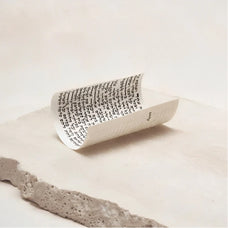
The case is what your guests notice. The mezuzah scroll inside is what makes it a mezuzah: two passages from Deuteronomy, the Shema and V'haya, handwritten in 22 lines on a small square of parchment, rolled up and tucked behind the case on your doorpost.
It's also the one part of the mezuzah you can't judge from a photo, so it's worth knowing who wrote it, how it's sized, and what you're paying for.
Written by Hand in Jerusalem
Every kosher mezuzah scroll in our collection is handwritten in Jerusalem by a certified sofer STaM, a scribe trained to write Torah scrolls, tefillin and mezuzot. He writes with a quill and special black ink on klaf, the kosher mezuzah parchment made from the hide of a kosher animal. Each finished scroll is inspected and certified before it's offered for sale.
That's why a scroll the size of an index card costs what it does. You're paying for a trained hand and hours of focused work, not a printer. Something to keep in mind if you come across a scroll that seems too cheap to be true.
Choosing the Right Mezuzah Scroll Size
Mezuzah scroll size is measured by height, and it should match the case, not the door. Our scrolls come in 7 cm (2.8"), 10 cm (4"), 12 cm (4.7"), 15 cm (6") and 20 cm (8").
Every SURI mezuzah case lists the scroll size it holds on its product page, so the easiest order is case first, scroll second. Already have a case? Measure the length of the inner cavity and choose the closest size that fits without forcing. Never fold or trim a scroll to make it fit; damaged parchment can make it unfit for use.
Planning something bigger for the front door? Browse our mezuzah cases for larger scrolls.
Kosher, Deluxe or Ultra-Premium?
Every scroll here is kosher and fully fulfills the mitzvah. The tiers describe how far the scribe goes beyond the minimum: the precision and beauty of the lettering, the quality of the parchment, and the level of checking each scroll receives.
A kosher scroll is a sound choice for any doorway. Many families choose a higher tier for the front door, or as a gift for a new home, the way you'd buy a finer edition of a book you plan to keep for life.
Once you've chosen, give it a home. Our mezuzah cases come in concrete, ceramic, metal and more, matching mezuzah sets cover the whole house, and the All Mezuzahs page walks you through hanging it.
Mezuzah Scroll FAQ
What makes a mezuzah scroll kosher?
It has to be handwritten by a trained scribe, with kosher ink, on genuine parchment from a kosher animal, and every letter must be complete and correctly formed. A printed or photocopied scroll isn't kosher, however good it looks.
Do I need an Ashkenazi or a Sephardic scroll?
The words are identical; the shapes of some letters follow different scribal traditions. Our Ashkenazi scrolls are written in Beit Yosef script, and our Sephardic scrolls in the script used in Sephardic and Mizrahi communities. Follow your family's custom. If you're not sure, ask your rabbi. Both are fully kosher.
How often should a mezuzah scroll be checked?
Traditionally, twice every seven years, by a qualified scribe. Check sooner if the scroll may have been exposed to moisture, heat or direct sun, which can fade or crack the letters.
Which way do I roll the scroll?
Roll it from left to right, from the end of the lines toward the beginning, so the word Shaddai, written on the back, ends up facing outward. Place it in the case with the top of the text facing up.
Can I move a scroll to a new case?
Yes. A kosher scroll can go into any case it fits, so you can update the look of a doorway and keep the scroll. It's a good moment to have it checked, too.
Where can I find a kosher mezuzah scroll for sale?
Right here at SURI. Every scroll in this collection is handwritten in Jerusalem and certified, and each product page lists the script, size and tier, so you can match it to your case with confidence. Orders from $150 ship free in the US.
The case gets the compliments. The scroll does the work. Choose yours from SURI's collection of handwritten kosher mezuzah scrolls.